Professor Voss carried no books into the lecture hall. Morning light entered through a row of high fortress windows and crossed benches polished by generations of restless hands. The room smelled of chalk, damp uniforms, and the lamp oil used before sunrise. Voss set a wooden box on the front table, took one stick of white chalk from it, and surveyed the rising tiers until the last conversations ended. The silence reached the back in pieces. A whisper near the windows survived longest. Voss waited for its owner to notice, then turned to the slate without acknowledging the victory and drew one straight line from shoulder height to the bottom of the board.
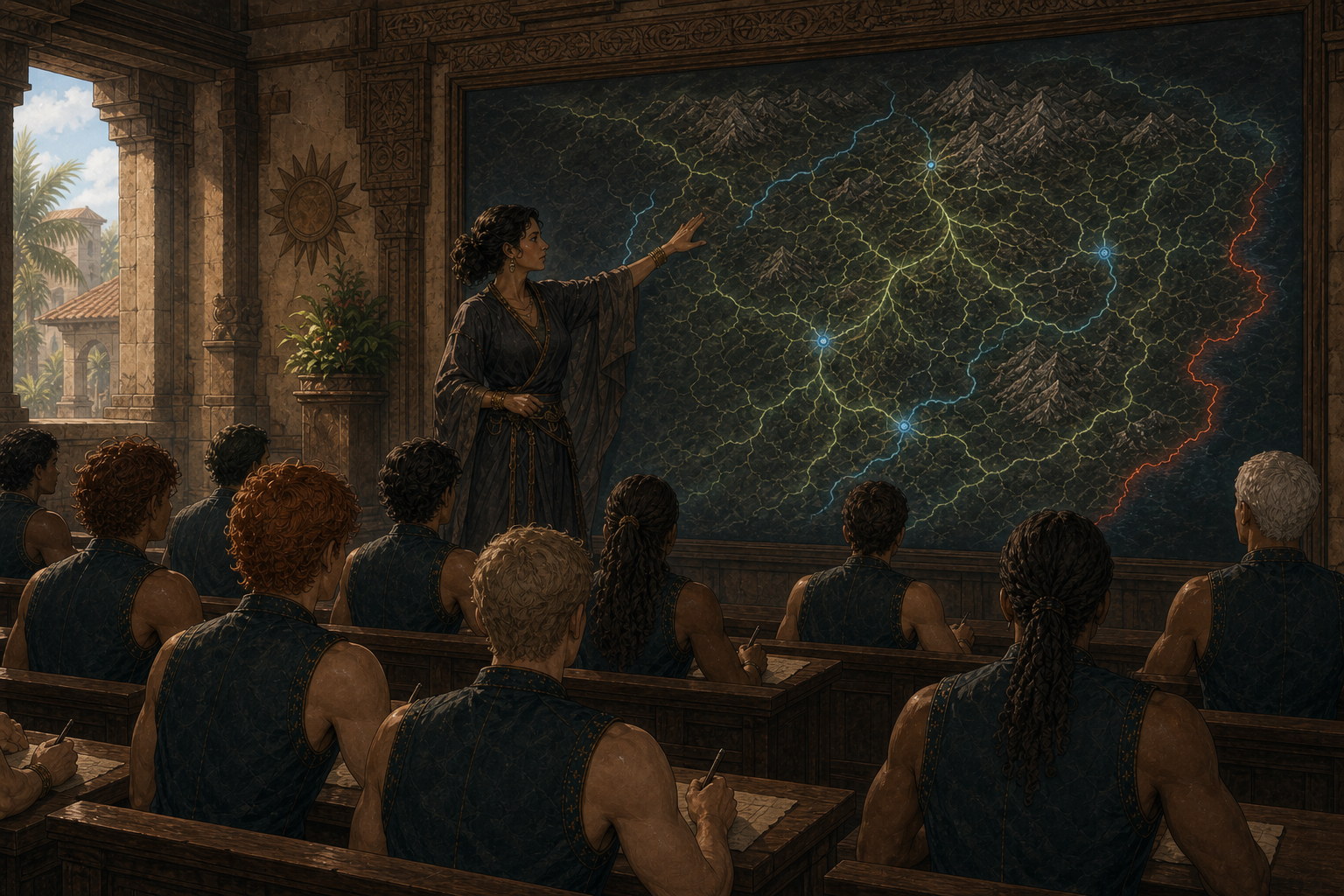
Light gathered in the chalk mark. Fine green branches spread from it across the slate, dividing and dividing again until the wall held a map of rivers, roads, and borders. Mountain ridges rose in gray relief. Three blue points burned where roads crossed water, and a red line followed the eastern bank before vanishing behind the professor's shoulder.
Jack forgot his schedule for several breaths. Until now, magic had been small, practical, and treated as ordinary. Voss had drawn one line, and half a country had opened around her hand.
She wrote three groups of symbols above it, and the marks meant nothing.
"Event," Voss said, tapping the first. "Account. Significance."
Jack tracked the word from her mouth to the slate. The first group remained a hook crossed by two short strokes. The second curved back through itself. The third was longer, disciplined and impenetrable.
Around him, paper shifted and quills began scratching.
Kai opened his bag. The flap had appeared soft and carelessly folded while it occupied the seat, but the inside had been divided into narrow fitted pockets. He removed a slim packet of cream paper, counted two sheets without seeming to, and placed one in front of Jack. Then he took the graphite from behind his ear, snapped it cleanly against the edge of the desk, and set the longer half on the paper.
Jack turned toward him, but Kai was already writing. His posture had changed by degrees rather than all at once. One forearm rested along the desk. His shoulders remained loose, but his attention had narrowed to Voss and the slate. The hand that stole food and waved through every story formed small, exact characters in even rows. He had not blotted a line, misplaced a mark, or asked whether Jack needed help. Jack took the graphite.
Voss tapped the first heading again. "An event occurs whether anyone understands it or not. An account is made by someone who saw, heard, survived, profited, inherited, or lied. Significance is what later people claim the event changed. Confusing these is how history becomes worship."
The first word shifted.
It did not glow. Nothing passed through the room. The hook remained a hook, the cross-strokes black where the chalk had caught in the slate. But when Voss said event, Jack knew where the word ended. He knew the final mark should open toward the left. The knowledge arrived without translation, closer to recognizing a face seen years before than learning a new alphabet.
His headache tightened behind the healing cut on his cheek.
Jack copied the word. The first stroke leaned too far. He stopped, checked Voss's hand, and tried again beneath it. His fingers wanted to hold the graphite like the mechanical pencil he had used at school. That part was his. Beneath it, something older objected to the direction of the line.
He changed the angle.
A room flashed behind his eyes: winter light across a polished table, his hand much smaller and holding a quill, a man's square signet striking the margin beside an unfinished character.
Again.
The word carried no voice he could identify, only impatience and the remembered dread of making the same line badly twice.
Jack's graphite stopped. The lecture hall returned with his hand clenched around it.
Kai glanced at the broken point. He slid the second half of the graphite across without looking away from Voss.
Jack loosened his grip before accepting it. He would not let a dead boy's childhood tutor frighten him out of writing one word.
Voss drew a circle around the map's southernmost blue point. New chalk light moved through the roads feeding it. Some brightened. Others faded until a single crossing held the weight of every line around it.
"Pashmena," she said.
The name appeared beneath her hand. Jack heard the first sound and found it waiting in the first two marks. The rest did not become English. They became Pashmena. Once he knew it, he could not force the characters back into nonsense.
Voss faced the room. "What was the significance of the Battle of Pashmena?"
Several hands rose. Kai's did not. He turned the graphite between his fingers and waited, precisely as he had warned Jack to wait.
Voss selected a broad-shouldered student near the center aisle.
"It ended the Eastern Rebellion," the student said.
"The rebellion continued for eleven months."
The student's hand lowered.
Another rose. "It secured the river crossings for the Crown."
"Two crossings were lost again before winter."
Three more hands went down without being called upon. Voss returned to the slate and added a second line beneath the battle's name. She said nothing while the room copied it.
The new words hovered near understanding. Jack caught Crown because she had just spoken it. River emerged a moment later from the marks beside the glowing waterway. Between them lay a word he could almost reach. He stared until the edges of the slate softened.
"Mr. Drake."
His head came up.
Voss had not consulted a roll. The emeralds had named him before he entered, or someone at the front had. Heads turned through the lecture hall with far less restraint than they had used in the dining room.
"What was the significance of Pashmena?" she asked.
Jack could have repeated one of the failed answers in different words. The old school instinct was still alive in him: say something adjacent, keep talking, hope the teacher found enough correctness to stop digging. It had saved him from homework he had not finished and questions he had only half heard. Here, it would announce ignorance with his mouth open.
He studied the map. Roads converged. Borders crossed them. The battle had been one thing to the Crown, another to the rebellion, and something else to the people whose homes sat beneath those glowing lines. Voss had spent the beginning of the lesson separating the event from what later people said it meant.
"To whom?" Jack asked.
Someone near the front breathed out a laugh and swallowed it when Voss turned her head.
She put the chalk into its box. "Better."
The word did not sound like praise. It sounded like permission to continue standing where he had chosen to stand.
"To the Crown," she said, "Pashmena demonstrated that the eastern coalition could be divided. To the coalition, it demonstrated that their lords would sacrifice one another's forces to preserve private roads. To the villages along this river, it began three years of requisitions, displaced courts, and soldiers living in houses whose owners had nowhere else to sleep."
She touched each region as she spoke. The chalk roads answered beneath her fingertip.
"The event was one battle. Its significance depends upon the question being asked and the person forced to live after the answer. Mr. Drake has not told us what Pashmena meant. He has identified the flaw in the question. Those are not the same achievement. Record the distinction."
Quills resumed. The attention left Jack slowly enough that he felt each part of the room release him.
Kai wrote one short line. His mouth had curved at one corner, but he kept the expression aimed at the page.
Jack bent over his own paper. He could read two of the headings now. Event. Significance. Account came when Voss used it again, the spoken sound settling into the looped word as though a catch had finally found its place.
He began taking notes.
Calling the result writing was generous. His lines wandered. Several characters opened in the wrong direction before his hand corrected them. He left spaces where Voss moved faster than he could follow and marked those places with short dashes so he could find them later. The graphite spared him the ink, nib, and pressure that had defeated him at Housing. When a word refused to come, he copied its shape and waited for Voss to say it again.
The method worked, though not evenly. Common words returned first: road, king, winter, army, grain. Longer terms remained crowded thickets until repetition opened a path through them. A few carried memories that were not facts. Treaty came with the smell of sealing wax. Province arrived beside a man's bored voice correcting Jack's posture at a dinner table he had never seen. Duty produced such immediate contempt that he knew the feeling belonged to the dead boy before he knew what had caused it. Jack wrote the word anyway.
The recovered language did not make him the person who had first learned it. Reading was another inherited tool, except a remembered opinion could move inside a sentence before Jack recognized who had supplied it.
He drew a line beneath his notes and kept his attention on Voss rather than the dead boy's handwriting trying to emerge from his hand.
The lecture moved from Pashmena into records. Voss opened the wooden box again and removed three objects: a cracked clay tally, a folded military order under glass, and a child's shoe gone gray with age. She set them along the table without ceremony.
"Which is a primary source?" Hands rose more cautiously this time. Voss pointed to a girl beside the aisle.
"The order," the girl said. "It was written during the campaign."
Voss rested two fingers on the cracked clay. "And the tally?"
"A trade record."
The professor moved her hand to the little gray shoe. The leather had collapsed inward with age, but one lace remained tied. "And the shoe?"
The girl hesitated long enough for several raised hands to climb higher. "An object."
"Everything on this table is an object. One has merely been trained to flatter scholars by containing sentences."
A few students smiled. Voss did not. She rotated the clay tally so the class could see five deep cuts along one side and two shallower marks on the other.
"The order tells us what an officer wanted done. It does not prove the order was obeyed. The tally records grain measured at a storehouse. It does not tell us whether the grain reached soldiers, villagers, rats, or a merchant's private cellar. The shoe tells us a child was present where the object was recovered. It does not tell us the child's name, survival, allegiance, or opinion of the war. Evidence does not become honest because it cannot speak."
She wrote evidence beneath the three headings.
Jack knew the word before the chalk left the slate. Relief struck so suddenly that he nearly laughed. He lowered his head and copied it instead. The letters came out narrow and uneven, but they were letters. He could read what his own hand had made.
Beside him, Kai turned a page. His notes occupied less than half the paper Jack had used and contained twice as much. The characters were compact without crowding, and small bars in the margin separated claims, examples, and corrections. Kai caught Jack studying them.
He placed one finger against his lips, solemn as a conspirator, then returned to writing.
Jack faced the front before his mouth betrayed him.
Voss let the map fade. Green roads withdrew toward the original chalk line, the mountains flattened, and the rivers darkened until ordinary slate remained. She brushed the three objects back into their fitted places and closed the box.
"Your first written assessment concerns the Witch Purge of 2890," she said.
She wrote the title in a single unbroken line.
The phrase opened inside Jack before he could defend against it.
Witch. Purge. The year followed, familiar numbers shaped a little differently from his own.
A dining table surfaced in memory. Heavy silver beside white plates. A man's hand turning a wineglass by its stem. Necessary unpleasantness, spoken with the mild impatience reserved for weather and taxes. The dead boy had been younger. He had believed the speaker because belief had cost him nothing.
The memory vanished before Jack saw a face.
His hand had tightened around the graphite again. This time he caught it before the point broke.
"Four pages," Voss continued. "Pre-war history. Primary sources where available. Everyone knows the outline, which means repeating the outline will earn you the mark appropriate to work a child could have produced from memory. I want what you can prove."
Jack copied the title. The first word required three attempts. Purge arrived whole. Beneath it he wrote four pages and primary sources. His writing looked like something produced in a moving car, but he could read every line.
The bell rang while Voss was still explaining citation order. Nobody stood. She finished the sentence, capped the chalk box, and dismissed them with a movement of two fingers.
Benches opened into the aisles. Jack remained seated while the first press of students climbed past. He read the assignment again. The words stayed.
Kai packed his paper into the fitted pockets of his bag. He left the graphite in front of Jack.
"Thank you," Jack said. "For this. And the paper."
"Keep the graphite. You press like you're trying to carve your notes into the desk, so I don't expect it to survive the week."
Jack compared the broken point with Kai's immaculate pages. "You hide being insufferable better when you're writing."
"That's why I speak whenever possible."
The answer was ridiculous, but Kai's attention settled briefly on the cut across Jack's cheek. If he had formed a question, he chose not to make Jack answer it in the crowded hall.
Jack slid the assignment beneath his schedule and stood. Voss was returning the wooden box to a cabinet behind the lecture table. He could leave before she addressed him again. The thought held him for one step.
Then he turned toward the front.
Kai caught the strap of his bag and moved out of the aisle. "I'll be by the door."
Jack walked down alone.
Voss closed the cabinet. "Mr. Drake."
"Professor." His voice stayed lighter than he wanted, but it did not climb. "Where would you start if you needed primary material and didn't want to repeat the outline?"
Her gaze moved once to the healing cut and returned to his eyes. "The Athenaeum keeps the pre-war catalog in the east reading room. Begin with the civil inventories, not the trial accounts. Trials are written to justify their outcomes. Inventories are written by people who want every missing spoon blamed on someone else."
Jack nodded. The advice made sense in a way most of the Academy did not. "East reading room. Civil inventories. Thank you."
"Your citations will still be judged."
"I assumed they would be."
Voss's expression did not warm, but something in it stopped pressing. She took another piece of chalk from the box and turned back to the slate. The interview had ended.
Kai waited outside with one shoulder against the wall, his brass chain straight and his bag closed neatly at his feet. Students streamed around him toward the stairs. He pushed away when Jack emerged.
"You voluntarily prolonged a conversation with Voss," he said. "I had been reconsidering my excellent first impression of you. This has helped."
Jack unfolded the schedule instead of answering. The paper no longer presented a field of hooks and loops. Not all of it yielded. Instructor names remained difficult, and one room notation refused to become anything but three cramped marks. The blocks themselves had meaning now.
The first block read General History, West Lecture Two. Midday Meal divided the page, and beneath it waited War Arts in the East Yard. Jack read the last line twice. The words did not disappear.
Kai leaned close enough to follow his finger without taking the page. "East Yard. That's mine as well."
"First, show me where students buy paper and graphite."
Kai considered the sheet Jack had saved and the borrowed graphite in his hand, then returned his attention to Jack. Whatever question waited behind his eyes remained there.
"Supply arcade," he said. "The honest shop is farther away and the dishonest one has better sweets. You should know both before making an ethical decision."
Jack folded the schedule along its old creases. The words remained inside it, waiting where he had put them. He gestured for Kai to lead the way and followed him into the traffic toward the stairs.