Jack woke to something cracking above him. He opened his eyes beneath the roots and did not know what he had heard. The shelter had brightened from black to the green dimness of light passing through leaves. Water ticked from the fern outside. A second crack came from somewhere overhead, followed by a wet tearing sound and the industrious tap of a beak. A bird was eating breakfast. Jack's body received the news poorly.
Hunger seized him before he had fully uncurled. It was no longer the clean, clawing agony that had folded him over after the ring healed him, but it occupied everything from his throat to the bottom of his belly. His mouth felt dry despite the night's rain. His jaw ached at the thought of chewing. When he pushed himself upright, his stomach drew in so sharply beneath his ribs that every ridge of muscle stood out. He stopped and waited for the headache. It did not come.
There was soreness at the back of his skull, broad and deep as a bruise beneath his hair. Turning too quickly made the shelter shift by a fraction before settling where it belonged. Nothing pressed behind his eyes. Nothing flashed across them. He could remember where he was, how he had reached the roots, and what he had done beneath them. That final memory encouraged him to leave promptly.
Jack crawled from the shelter on hands and knees, lifting his hips before anything could drag through the mud. Outside, the air was already warm. The ring remained a quiet pressure against his pubic bone.
He checked the wounds. They remained closed, although the hip pulled when he straightened. The body had repaired almost everything except its need to eat.
Jack stepped around the fern and found the three stones where he had left them. Rain had washed their upper faces clean. They made a small, foolish monument beside the road, and he loved them for being exactly where they ought to be. The road looked different by morning.
Fresh marks had been laid over the storm-softened surface. A horse had passed recently enough that the edges of its prints remained sharp. Two narrow wheels had cut parallel lines through a shallow patch of mud, and water had only begun to gather in them. Along the higher verge, vines had been severed and thrown back before they could trail across the way. The cuts were pale, no more than a few days old. Someone maintained this road.
Jack crouched at its edge. A stone-lined channel carried water from the uphill forest toward a culvert beneath the paving. Leaves crowded the little channel but did not block it. As he watched, one broad brown leaf drifted to the mouth of the culvert, caught there, and trembled. Then the water climbed.
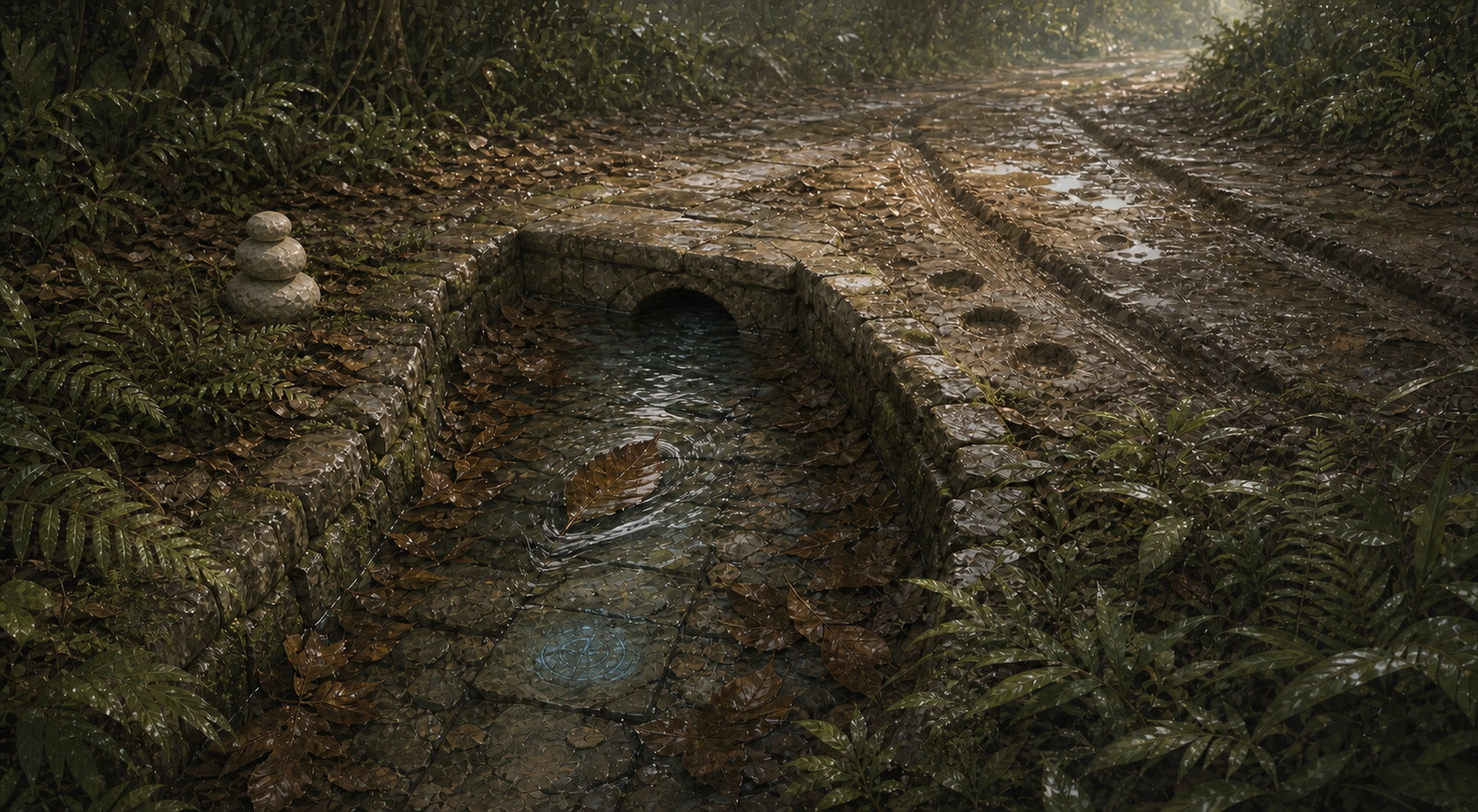
It rose the height of Jack's smallest finger against the natural fall of the ground, carrying the leaf with it. A blue mark glimmered beneath the surface on one of the fitted stones. Water and leaf slipped together through the culvert. The mark faded. The channel resumed flowing as though it had not just contradicted gravity. Jack stared after it.
"Fine," he said. "Magic drains. Of course."
Water continued through the culvert. The proof of traffic made his direction feel less ridiculous, but it did nothing for his stomach. He studied both sides of the road while he walked. The green-gold fruits from yesterday had not seemed rare. Birds had known them, and the road might carry seeds farther than any one tree's shadow. He found the first silvered rind before he found the tree.
It lay at the bottom of the ditch with its orange flesh eaten cleanly away. Another rested several paces beyond it, torn open beneath a screen of glossy leaves. Above them, three young trees leaned out of the forest toward the broken light over the road. Their branches were not high enough to mock him. Green-gold ovals hung beneath the leaves in clusters, some hard and dark, others silvered with ripeness. Jack laughed once, breathlessly.
The sound seemed too large after a night alone. A flock of the little dark birds burst from the branches, red patches flashing beneath their tails. He reached for the nearest ripe fruit before they could reconsider ownership. He washed it in the road channel, split the skin with his thumbs, and ate.
Sweet orange flesh yielded around the flat black seeds. Juice ran over his fingers. The first fruit scarcely touched the hunger. The second quieted the ache in his jaw. He ate the third more slowly and sat on one of the culvert stones for the fourth, scooping the flesh from the skin with his teeth. By the fifth, his belly had stopped trying to consume the rest of him.
Jack held a sixth fruit in both hands and considered it. He was still hungry, but it had become an ordinary hunger, the sort that could wait for bread, eggs, or anything warm enough to have a smell. Eating until he made himself sick beside the road would solve nothing.
He set the fruit on the culvert stone. He could come back for it if the road remained empty. The road did not.
At first the sound belonged to the forest's endless dripping: a dull beat arriving without direction. Then iron struck stone. Leather creaked. Wheels ground through softened gravel with a wet, wooden complaint. Horses. Jack looked down at himself. "Oh, hell."
The road bent behind him. Whatever approached was still hidden by trees, but the clopping grew louder with each breath. He snatched the fruit from the stone through an instinct against waste, hesitated with it in his hand, then placed it beneath the glossy leaves and hurried off the road.
He did not plunge into the forest. Ten paces beyond the ditch, an enormous tree divided into buttressed walls of wood before rising into the canopy. Ferns filled the spaces between them. Jack slipped behind the nearest buttress and lowered himself where he could watch through overlapping fronds.
Squatting brought his knees wide. His cock and balls hung in the open space between them, safely above the leaf mould, while one hand steadied him against the ridged bark. He could remain there. He only needed not to sneeze, slip, attract an insect, or present any portion of himself through the fern. The approaching wagon had not yet appeared. Waiting made him aware of the air.
A light breeze followed the road through the trees. It reached beneath the fern and moved over skin that had been wet, cold, hurt, or frightened since he awakened. Now the air felt good. It passed along the inside of his knees and tickled the loose skin of his low-hanging sack. His balls shifted with it. His cock gave a sudden, interested jump beneath his belly. Jack stared down. "Really?"
The shaft thickened by a degree, lifting from its soft hang without becoming hard. His body was fed and warm, and movement no longer hurt everywhere. That was sufficient cause for celebration. The breeze touched him again. Night opened behind his eyes.
Not this forest night. A town, close-built and dark, rushed past him in broken pieces. Stone beneath bare feet. Shuttered windows leaning over a lane too narrow for daylight. Cool air streamed over a body as naked as it was now while a boy his age ran naked beside him, pale hair flying loose and one hand clamped over his mouth to hold in laughter.
"Stop this instant!" a guard bellowed somewhere behind them.
That nearly finished both of them. The pale-haired boy caught his wrist and dragged him beneath an arch before their laughter could steal the strength from their legs. Their bare shoulders struck the wall. They clung to each other, breathless and helpless, while a lantern bobbed at the far end of the lane.
The boy grinned, dropped to his knees, and closed his warm mouth over Jack's cock. In the memory, Jack leaned into the warm mouth. He felt the answering pleasure before he could decide whether it belonged to the dead boy or to him. The pale head bobbed twice, then a third time, each a quick, wet pull while both of them struggled not to laugh aloud.
The guard shouted again, closer now. The boy let the shaft slip from his lips, sprang up, and seized Jack's hand. They fled the arch together, naked and giggling, with the lantern's glow swinging after them. Then a room.
A door kicked shut. Lamplight across a bare back. A mouth against his neck to swallow another laugh. Cold skin warming against cold skin, then heat, the salt of sweat, and the weight of that same body drawing him down into a bed already in disorder. Wanting surged through Jack with the memory. He came back crouched beside the road, one hand dug into tree bark and his cock half hard between his knees. The wagon rounded the bend.
Jack's face burned. He fixed his attention on the road with such determination that the first horse might have been an examination question.
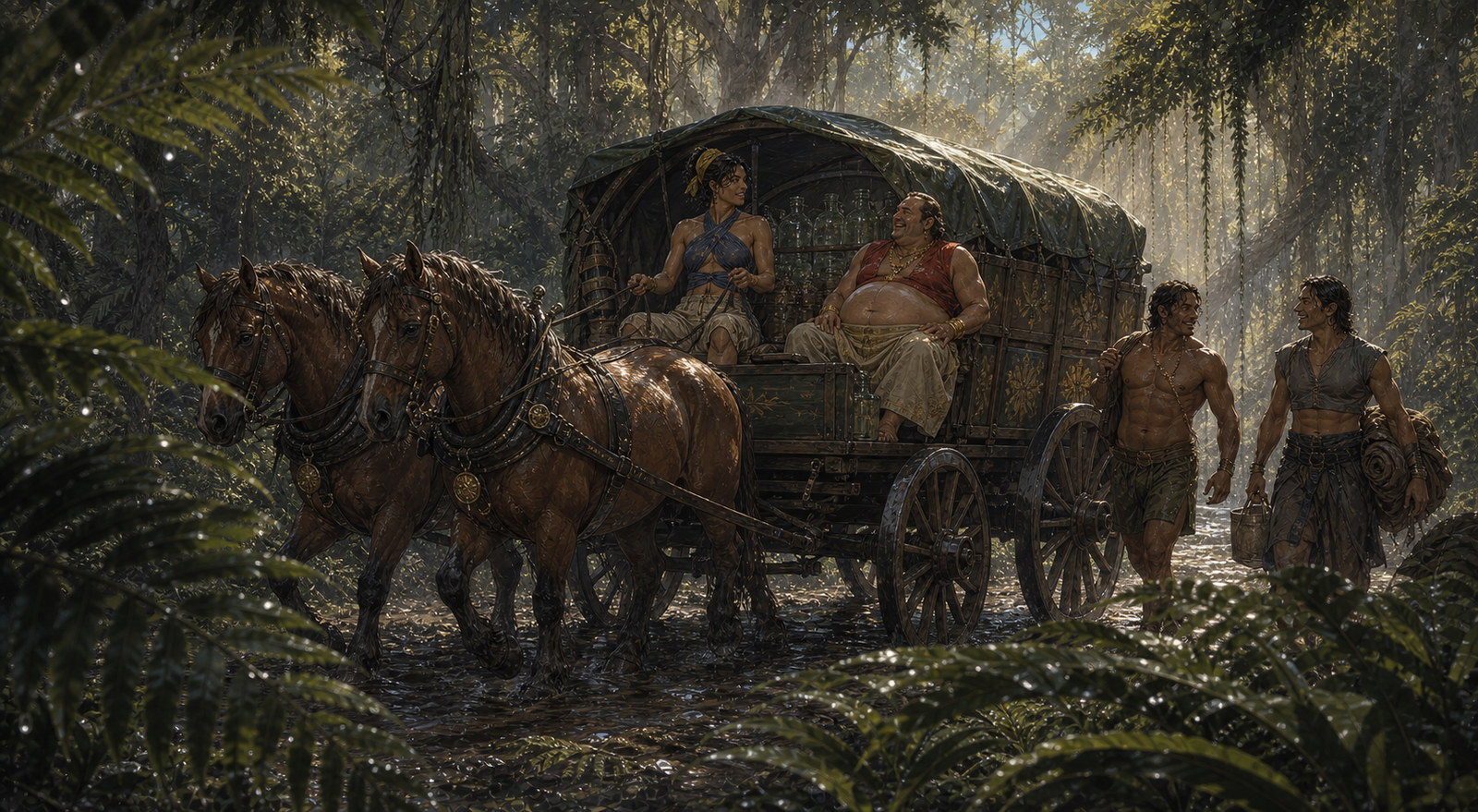
There were two of them, broad-backed chestnuts darkened by rain along their legs. Brass discs hung from the harness and flashed whenever a shaft of sun found them. The wagon behind was roofed in waxed green cloth, its sides painted with yellow vines badly enough that Jack could see the brushstrokes from his hiding place.
A woman drove. She wore a blue wrap crossed over her chest and tied beneath it, leaving her stomach bare above loose divided trousers that ended at the knee. Her arms were brown and heavy with muscle. A strip of yellow cloth held her hair from her face. Beside her sat a prosperous-looking man in cream and red. He was far too fat to be wearing so little.
The thought arrived complete and immediate. The man's sleeveless red garment ended well above his navel. A cream kilt wrapped his hips, leaving his round belly wholly uncovered where it rested over the waist. Gold chains crossed his chest. More gold circled both wrists and glimmered in the soft folds beneath his chin.
He did not tug the garment down. The driver did not glance at his stomach. Two workers walking alongside the wagon wore less than he did: one bare-chested in short green trousers, the other in a cropped grey tunic and a wrap-skirt divided for walking. Nobody appeared to be suffering a public disgrace. The fat man lifted the front of his red garment and wiped rain from his face with it. Jack reconsidered.
The day was warm already. The forest sweated around them. Cloth that covered more skin would only become another wet thing requiring care. The man's kilt was richly woven, his wrap precisely fitted, and every bright piece of him announced money. He was not dressed despite his size. He was dressed exactly as he meant to be. Jack, hiding naked in a fern with an inconvenient erection, was not in a position to govern anyone else's dignity.
"At this pace, we'll hear the noon bell before we see the Briartown gate," the man said.
Jack's attention sharpened. "You asked me not to shake the glass," the driver replied.
"I asked you not to break it."
"Then we'll reach Briartown when the road permits."
The nearer worker laughed. The fat man made a wounded sound and settled against the seat as the wagon passed. Briartown.
Jack understood the word. He understood all of them. He could have called out.
The realization came while the wagon remained close enough to stop. Four adults, two horses, covered cargo, and a road leading precisely where he needed to go. They might have spare cloth. They almost certainly had food. The driver looked competent; the workers looked ordinary; even the passenger's worst visible crime was impatience. Jack opened his mouth.
The memory of lamplight moved again behind his eyes. His half erection had not subsided. He was naked, scarred, filthy, and unable to say where he had come from.
Someone had cut this body open, stripped it, and discarded it beside the road. Until Jack knew why, friendly-looking strangers were still strangers. He closed his mouth.
The wagon continued toward Briartown. One worker said something too quiet to catch. The driver's answer carried back as a burst of laughter. Branches closed behind them, then opened again around the diminishing roof. Jack remained hidden until the last harness bell faded.
When he stood, his knees objected. He waited behind the tree until his cock softened and hung low again, then returned to the road. The fruit remained where he had left it beneath the leaves. He retrieved it and carried it in one hand as he followed the wagon's new tracks. His choice of direction had been luck. Now it was a road to Briartown.
The forest changed by small degrees as he walked. Cut stumps appeared beyond the ditch, old enough for moss but too square to mistake for storm damage. A low wall wandered among the trees, its stones swallowed by roots. Twice he passed drainage marks like the first, blue lines beneath clear water coaxing leaves through culverts that should have clogged years ago. Then another road joined from the south.
It was narrower, paved only at the meeting, but its ruts were fresh and numerous. A waist-high stone stood between the two routes. Rain had darkened an engraved sheaf of grain on one face and a many-windowed tower on the other. Jack could not read the shallow lettering beneath either symbol. The shapes stirred nothing in the inherited memory. He had barely passed the marker when he heard hooves again.
This time two riders came from the side road. Jack retreated behind a screen of broad leaves and watched them turn toward Briartown. Both wore short dark kilts beneath pale sleeveless coats, with high boots protecting their calves. Long staves rode in loops beside their saddles. The coats bore the same green emblem at the shoulder, though distance hid its shape. A patrol, perhaps.
Neither rider searched the verge. They spoke about a washed-out garden wall and whether someone's husband had built it badly enough to deserve the repair bill. Their voices faded up the road. Jack emerged. He made it forty paces before a donkey cart rattled from the side road. Back into the leaves.
An elderly couple occupied its narrow seat, both in loose wraps that bared their shoulders and stomachs. Bundles of wet reeds filled the cart behind them. The woman complained about mildew. The man blamed the roof. Neither noticed Jack watching from behind a tree. He waited, returned to the road, and walked faster.
Three people approached on foot before he had found his rhythm. Jack heard their conversation in time to hide, though not gracefully. He stepped into the ditch, crossed the enchanted drainage channel in two long strides, and crouched behind a fallen limb furred in moss.
They were Academy students, or at least the first people he had seen who might be. All three were near his age. One wore a pleated kilt and a cropped white wrap edged in blue; another had short fitted trousers, a bare chest, and a blue sash passing from shoulder to hip. The third wore a loose sleeveless tunic with open sides over an equally blue wrap-skirt. Their clothes showed stomach, back, thigh, and the easy carelessness of people who had never been taught that those parts required concealment. The sight would have been a feast under different circumstances. Jack held the unbitten fruit over his crotch and tried not to breathe loudly.
The students passed arguing about an examination. Jack caught the words wards, structure, and east practice hall, but none of the rest gave him anything useful. He stayed down until their voices vanished around the bend. By then he was beginning to resent civilization.
The empty road had offered no food, clothing, or answers, but at least it had permitted him to walk down its middle. This road gave him proof that he was close to all three and then drove him into the shrubbery every few minutes.
Jack climbed from the ditch. He ate the final fruit as he walked, tearing the skin with his teeth and spitting the black seeds into the verge. Perhaps in a few years another hungry fool would find a tree there.
Ahead, through gaps in the trunks, the road had begun to brighten. The canopy thinned. Sun lay across the stones in broad white bars, and somewhere beyond the forest a bell sounded once, too deep and ordered to belong to any bird. Jack quickened his pace. Wheels answered from behind him. "You have got to be kidding me."
He fled the road again with sticky hands, crossed the ditch, and pushed into a stand of ferns tall enough to conceal him. Their wet fronds closed over his shoulders. He lowered himself between them, knees apart, one palm against the earth, and listened to the next wagon approach the junction. The road ahead was no longer empty enough to belong to him.