Jack found his own way down from the wall. The last drop put both feet beneath him, just as he had insisted it would. His knees bent. The borrowed cloak pulled tight across his thighs but remained knotted, and he landed in the tannery yard with nothing worse than grit under his palms from the wall. Three workers had watched the whole descent while pretending to scrape hides.
One of them, a broad woman with her hair wrapped in red cloth, rested her knife across the beam. A copper hoop swung from one ear. "You're using my wall again."
Caleo adjusted the collection bag on his shoulder. "Your gate was closed."
Jack turned. The gate stood open behind her. He caught the knot at his hip as if discovering the danger again.
"You made me climb a wall in this... thing! It could have come open at any time."
"I wouldn't have minded," Caleo said. He waved Jack's objection away and headed across the yard.
"Neither would I," the tannery woman said.
Jack sighed and blushed from his throat to his ears. The woman returned to the hide with one corner of her mouth raised.
Jack followed him between vats large enough to drown in. The yard smelled of lime, wet leather, urine, and something animal that the heat had worked deep into the stones. Workers stood bare-armed and bare-bellied in stained aprons, their feet protected by thick wooden sandals. Blue marks glimmered along the rims of two vats, keeping the liquid inside at a slow turn without paddle or hand.
No one challenged Jack's presence. One man glanced at the scar on his cheek and then at the sarong. Whatever conclusion he reached, he kept it. Caleo slipped through the open gate into a lane barely wide enough for a handcart. Briartown closed around Jack.
Beyond the worker lanes, the city spread across the broad lower slopes and into the basin beyond, roof after roof descending through a haze of cook smoke, kiln smoke, and damp heat. Streets vanished behind whole districts and emerged again as pale lines on the opposite rise. Above all of it stood a fortress.
Dark outer walls crowned the hill, too extensive to belong to a single house. Square towers rose at uneven intervals where newer roofs and windows had been fitted behind the old battlements. However the streets turned, some portion of the fortress remained above the town: a tower between chimneys, a length of wall beyond the laundry, iron roofs catching the sun over crowded gables.
The houses leaned over the street in timbered layers, upper floors shading plaster patched in six different colors. Water ran through fitted channels at both sides of the paving. Laundry crossed overhead on ropes and moving pulleys. Somewhere above, someone beat a rug against a rail. A woman shouted the price of onions from a doorway. Hammers answered one another from workshops farther down the hill. Everything worked, though not cleanly, not quietly, and rarely without a repair showing. A broken gutter had been redirected with half a clay pipe and a square of hammered copper. One window shutter hung from mismatched hinges, both polished from use. At the next corner, a public pump bore a blue-white symbol like the culvert marks. A child pressed the handle, and cold water rose with a flash beneath the spout. Jack wanted to stop and inspect it. His stomach wanted breakfast more.
Caleo took three turns without hesitation and entered a narrow rear door beneath a painted loaf of bread. Warmth struck Jack first, followed by yeast, cinnamon, and browned butter. His body tightened around the smell so strongly that he had to put one hand against the doorframe.
The kitchen occupied most of the ground floor. Two ovens opened along the far wall, their black iron doors surrounded by old tile. A honey-colored stone sat in a cradle beneath each one. Lines of light moved through the stones like banked fire. Three bakers and two younger workers moved between the ovens, cooling racks, and long tables. One fed shaped loaves onto a wooden peel. Another braided ropes of dough with both hands while a flour-covered boy carried full trays toward the front shop.
A heavy woman commanded the central table, cutting dough with a broad knife while empty trays shifted themselves along a groove beside her elbow. She looked up at Caleo, then at Jack. The others looked too, but none of them stopped working. Her gaze took in the scar, the naked chest, and the familiar cloak tied around unfamiliar hips.
"Sit him down," she said.
Jack sat. The nearest chair had one leg shorter than the others and rocked beneath him. He put his bare foot on the crosspiece to steady it. The woman set down a wooden bowl filled with eggs, potatoes, peppers, and torn bread fried together in fat. A heel of fresh loaf followed. She placed a cup of water beside it and went back to her dough.
"Thank you," Jack said.
"Eat before you fall through my floor."
Caleo dropped the collection bag near a shelf. "Auntie, this is Jack. I found him hiding in the ferns beside the south road. He was completely naked, and he spoke a language I've never heard, except then he spoke ours, and he says that cut happened yesterday, but look at it. And the ring has marks from the old book. Some of the body ones. I think."
His voice climbed on completely naked and went higher again over the ring. He sounded like a child explaining how he had found a turtle in the road and why it ought to be allowed inside. Jack tightened one hand around the knot at his hip.
"Jack can tell me who Jack is when his hands stop shaking."
They had begun shaking. Jack had not noticed until she named it. He ate.
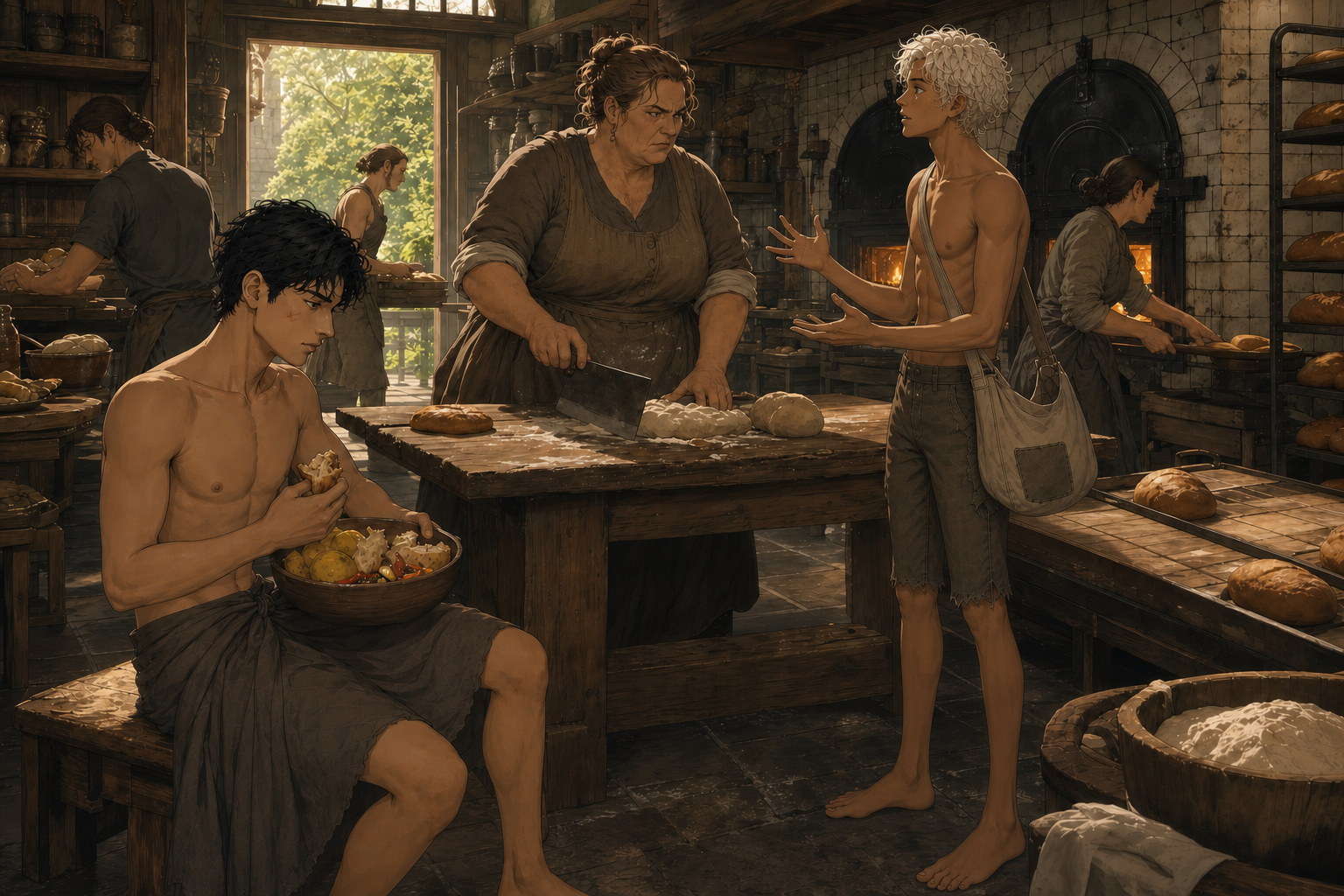
The first mouthful burned his tongue. He swallowed it anyway. Crisp potato gave way to soft egg and sweet pepper, with enough salt to make his eyes water after a day of fruit. He slowed only when the bowl was half empty and the kitchen had stopped narrowing around it.
Caleo opened his bag and laid the forest gathering across the end of the table. Moss went onto a drying screen. The pale root disappeared into a jar beneath damp cloth. He hung the blue-veined leaves in pairs from a line near the window, three leaves to each knot. Jack watched him do it correctly and returned to the food.
When one of the bakers reached the end of a row of unbaked loaves, Caleo washed his hands and stepped into the open place beside her. She passed him the scoring knife without asking. He cut three swift lines across each loaf, turned the tray, and sent it down the groove toward the ovens before returning to his bag.
The woman slid two cinnamon rolls from a cooling tray onto a square of paper. One went beside Jack's bowl. Caleo wrapped the other and tucked it into the collection bag.
"The one beside your bowl is yours," she told Jack.
"Thank you, ma'am."
"You can call me Mrs. Gowrie."
She returned to cutting dough. He ate his roll while it was warm. Cinnamon and sugar stuck to his fingers. Across the kitchen, Caleo inspected a row of small stoppered bottles, selected two, and put them in the bag with his untouched roll.
Jack finished everything Mrs. Gowrie had given him. Hunger remained, but it had become a distant, ordinary thing that could believe another meal would happen. The chair rocked when he shifted.
Jack lifted it by the seat. The shorter leg had not worn down. Its joint had opened beneath the frame, leaving a narrow dark gap where the glue had failed.
"Do you have a mallet?" he asked.
Mrs. Gowrie stopped cutting.
"Why?"
Jack turned the chair so she could see the joint. "The leg is working loose. If I drive it back and pin the corner, it should stop rocking." She pointed the knife toward a cupboard.
The tools inside were old but recognizable: mallet, awl, small saw, iron pincers, coils of wire, nails stored by size in chipped cups. Jack chose the mallet and a narrow wedge of hardwood from a box of scraps. He tested the joint with his thumb, scraped old glue from the edge, then drove the leg square beneath the frame.
The body gave him steadier hands than his own had been, but the work belonged to Jack. Pressure, grain, fit. He knew those. He trimmed the wedge, coated it with a little glue from a covered pot, and tapped it into the opened seam until the leg stopped moving. Caleo had come to stand beside the table.
Jack set the chair down and put his weight on each corner. No rock.
Mrs. Gowrie dragged it toward herself, sat once, and returned to her feet. She took the knife back up.
"Cupboard door next time," she said.
Jack glanced at the cupboard. Its upper hinge sagged.
"I can do it now."
"You can do it after Cal finishes the deliveries he's been avoiding by bringing home strays."
Caleo collected the bag. He did not defend himself.
Jack could have stayed. Caleo had done enough. Jack returned the mallet to the cupboard.
"I'm coming with you."
Caleo's smile appeared quickly and remained after he turned away. "Good. I need someone respectable to carry the criminal moss."
Jack picked up the drying screen instead of answering. Caleo took the hint and led him outside.
Their first stop was three doors down, where an old woman waited beside a shutter removed from its window. Ants moved along the lower edge in a black line. Caleo knelt, mixed a pinch of silver moss with oil from one bottle, and pressed it into a groove cut along the wood.
The old woman held a loop of red thread ready for him. Caleo tied it through two holes in the shutter, drew one symbol with his stained fingertip, and breathed across it. The thread tightened. A dull red light traveled from knot to knot. The ants broke formation and scattered into cracks between the paving stones.
"Three weeks?" the woman asked.
"If you don't wash the groove. The last one had a drier month."
Caleo capped the bottle and slid his hands beneath the shutter's heavier end. Jack understood and took the other. Caleo's narrow, scarred hands kept the frame level while Jack's forearms strained beneath his share of the weight.
Together they raised the shutter to the empty window. The old woman guided the iron straps over their pins while Caleo held it steady. When the last pin dropped into place, she swung the shutter closed, then open again. The red thread remained taut in its groove.
She accepted this and gave him a paper twist containing six sugared nuts. "Morning, Mayor."
"Morning, Mistress Vale."
Caleo ate one nut before they reached the corner. He offered the paper to Jack, who took one, and folded the remainder into his bag.
"Mayor?" Jack asked.
"A joke that outlived everyone responsible for it."
The answer closed rather than invited more. Jack let it.
The next lane opened into a market street. Canvas shades stretched between buildings, making colored rooms of the daylight. Fish lay over blue ice that did not melt. A seamstress displayed cropped wraps and short kilts on wooden forms. Men and women shouted over fruit, lamp oil, nails, spices, and secondhand books. Jack searched automatically for the markers he would have used at home.
There were no cars parked at the curb, no phones appearing whenever conversation paused, no new trainers beside split ones. Those differences belonged to everybody here and told him nothing. Poverty survived the missing inventions. It showed in cloth patched until the patch needed repair, in a knife sharpened narrow, in whether a person ever spent money on something that served no purpose except beauty.
Almost everyone wore some small ornament. A porter with rope burns around both hands had a copper ring in one ear. The fish seller wore blue beads at her throat. Two girls sweeping beneath a spice awning had braided colored glass into their hair. Even the tannery worker had possessed one swinging hoop. Caleo had nothing.
No ring, bracelet, earring, bead, chain, or guild cord marked him. His frayed shorts had been mended twice with different thread. The small knife at his hip had lost half the width of its blade to sharpening. Now his cloak belonged to Jack. At a narrow shop between the seamstress and a seller of ink, Caleo stopped.
Jewelry covered the back wall in modest rows. Most of it was copper, polished brass, colored cord, and glass. Near the center hung a small necklace: a green glass leaf on a fine bronze chain, no larger than the first joint of Jack's thumb.
Caleo's gaze rested on it. His fingers touched the bare place below his collarbone.
A price had been painted on a square of wood beneath the chain. Jack could read the numerals through the body's borrowed knowledge without understanding yet what the amount could buy. Caleo understood. After several breaths, he continued down the street.
He did not sigh. He did not make a joke about it. The empty skin at his throat became more conspicuous than the necklace had been. Jack followed.
They delivered the mushrooms to a woman boiling bandages in a courtyard, and the pale root to a man whose left hand had swollen around a splinter. Caleo opened the swelling with a cleaned needle, applied something ground from the root, and left one of the small bottles behind. Neither person paid him.
The woman gave him two little cakes flavored with lemon peel. Caleo ate one. He carried the other until a girl sitting beneath a stair called his name, then placed it in her open hand without interrupting his explanation of how often the bandage needed changing. Jack waited until they had left the courtyard.
"Why don't you charge them?"
Caleo shifted the lighter collection bag higher on his shoulder. "They have nothing to offer me that they can afford to lose."
"You need money."
"Yes."
Caleo did not soften the answer or pretend virtue made him less hungry. He held up the paper twist of sugared nuts. "People give me food. Thread. Soap. Whatever appears when they have extra. I keep what I need." Ahead of them, hammering rose above the market noise, followed by a man's shout.
"Move, boy! The mortar's setting while you dream over it."
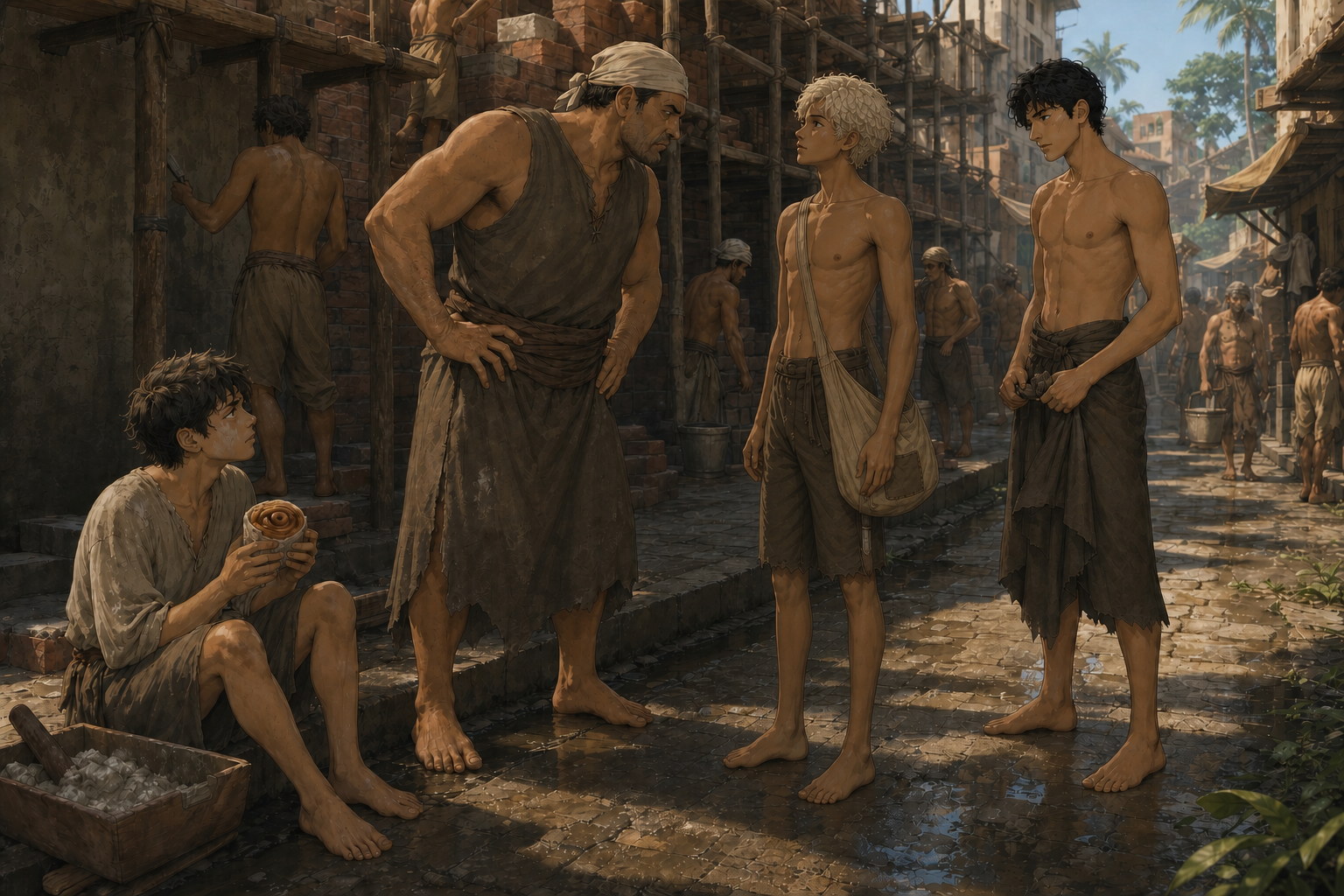
A brick building was going up beside a narrow square. Scaffolding covered its face. Men worked above with their stomachs bare and cloth wrapped around their heads against the sun. At ground level, a thin boy struggled to lift a wooden hod loaded with bricks.
He could not have been more than sixteen. His shirt and shorts had been cut for someone broader, perhaps older, and belted until the extra cloth folded around him. Redness ringed both eyes. Mortar dust streaked one wet cheek. The master mason shouted again from beside a mixing trough. Caleo stopped. He took the wrapped cinnamon roll from his bag and crossed the square.
"Ren," he said. "Put that down and eat."
The boy looked at the mason before lowering the hod. "He's working," the mason said.
Caleo placed the roll in Ren's hands. "You owe him six days' wages. He's been carrying your bricks since sunrise without breakfast, and your shouting can be heard from the dye market. Let him sit down."
The higher, boyish note Jack had begun to recognize in Caleo's ordinary speech was gone. His voice was not deep. It was level, unhurried, and left no room for the mason to mistake him.
The mason's face hardened. He was twice Caleo's width and old enough to be his father. Caleo stood before him in frayed shorts, bare feet white with road dust, and no badge or weapon except the narrow little knife used on roots. The mason scowled. Then he turned back to the mortar trough.
Ren sat on the curb with the roll held in both hands. Caleo crouched long enough to say something Jack could not hear. The boy nodded and began eating. When Caleo returned, Jack asked, "How old are you?"
"Eighteen."
The same age as Jack. Caleo walked on before Jack could find anything to say that would not sound like praise. At the next corner, a carter bent over a harness called, "Morning, Mayor!" Caleo raised one hand.
A woman leaning from a second-floor window asked whether the rat ward had held. When Caleo called back that he would check tomorrow, she thanked the Mayor loudly enough for the lane.
An old man outside a cooper's shop waved with his whole arm. Two children followed Caleo for half a street until he divided the remaining sugared nuts between them and sent them back. The title began to make sense. Some people still turned their faces away when he passed. A shopkeeper lowered an awning rather than meet his eyes. Jack wanted to know how a boy with no office or money had become so difficult to dismiss.
The rest of the afternoon passed in small work. Caleo read a letter to a woman whose sight had failed. Jack helped a grocer drag a grain chest away from the wall while Caleo replaced the frayed rat cord braided through its rear feet. They carried a sack of flour from a cart to the bakery. Caleo disappeared twice into buildings and returned both times, which Jack noticed more than he wanted to.
Caleo was easy around people. He remembered a cobbler's cough and a washerwoman's grandson. He flirted harmlessly with a fruit seller old enough to laugh at him and listened without interruption when a frightened man described a landlord entering his room. He used charm when it helped. When it did not, he listened or held his ground. None of it changed after Jack had eaten, worked, and ceased being an emergency beside the road. Jack could fall for him.
The admission came in Jack's own internal voice. No foreign street opened behind his eyes, no remembered mouth closed over him, and the ring remained quiet beneath the sarong.
He had never thought of himself as gay, or at least could not remember ever applying the word to himself. He had assumed a future without examining its details: apprenticeship, work, some home reached by the same streets he had always known. Whoever had owned this body had certainly desired boys; the naked run and the mouth beneath the arch had settled that much.
Perhaps the quickness of his arousal belonged partly to the dead boy. But the dead boy had never met Caleo. He had never watched him give away a cinnamon roll he probably wanted, seen him make a mason stop shouting, or felt relief each time he returned from a doorway. That belonged to Jack.
They reached the bakery near sunset. The enchanted oven stones had dimmed from honey to deep amber, and the day's heat escaped through the open rear door. Mrs. Gowrie put Jack to work on the cupboard hinge before he could ask. He reset the pin, added a thin washer cut from scrap leather, and made the door hang level. Caleo carried the empty collection bag upstairs. Jack finished the hinge and followed.
The room beneath the roof was larger than he expected and poor in a different way than the streets below. Nothing in it was ornamental unless it had been found. Bundled herbs hung from rafters. Papers covered a small desk, weighted by stones, cups, and tied packets. The bed was wide enough for two but the blanket had been mended along one edge. A gable window stood open above the bakery garden. A barn owl slept on the dresser in a nest made partly from socks.
Caleo set down the bag. The owl opened black eyes and gave a soft, questioning trill.
"Percy," Caleo said, and every public note left his voice. He crossed the room and stroked the owl's head with two fingers. "Hello, darling. I was gone longer than I promised."
Percy leaned into the touch and closed his eyes. Jack thought of a dog waiting beside an ordinary door in another world. The memory hurt differently now that he was fed and no longer alone enough to avoid it.
Caleo remained beside the dresser until Percy settled. Then he pulled a clean cup from beneath the desk, filled it from a covered pitcher, and gave it to Jack.
"Auntie has the bath heating," he said. "You can sit here until it's ready. Afterward, tell me whatever you can about the ditch. You don't have to make the missing parts sound sensible."
Jack sat on the edge of the bed with the cup between both hands. Below them, Mrs. Gowrie and the bakery hands cleaned around the last batch of loaves. Pans knocked together, someone laughed, and evening voices crossed the lane outside. Caleo opened the window another inch for the breeze, then stayed in the room with him even though the rescue was over. Jack drank and watched Percy sleep.