
Rain had found three ways through the roof of the Ash and Lantern, and Ethan Arnasis had found a fourth before Mara Venn did. It came down the western chimney breast in a thread so fine that it showed only when the fire leaned away from the stone. The water crept behind the old iron brace, gathered along its lower edge, and fell with patient little ticks onto the settle.
Ethan had been watching the brace because he had helped make its replacement. Not forged it, exactly. Master had done the weld and struck the square holes through while Ethan worked the bellows, but Ethan had upset the ends, drawn them back to width, and filed away the burrs. It was decent work. Better than decent, if a boy was allowed to think so of his own hands. The old brace had split at one hole and should have been changed before the wet season. The new one lay wrapped in sacking beneath the grain carter's bench, waiting for a dry morning and a ladder that did not rock.
“Another bowl,” Ethan told Mara when she passed.
She followed his eyes to the darkening stone. “I own more bowls than roof.”
“You need lead worked over the flashing.”
“I need three clear days and a roofer who does not smell profit whenever he sees an inn.” Mara fetched a shallow crock from beneath the bar and set it on the settle beside him. “Move your cloak. You are thin enough without letting the rain eat the rest of you.”
Ethan gathered the patched wool around his narrow shoulders. Mara had known him through six or seven trips with the grain carts, enough to feed him twice without asking and insult him when he failed to finish quickly. The Ash and Lantern stood halfway between the town where he worked and Briartown, close enough to the old Blackmere road that every heavily laden wagon made the cups tremble before its wheels appeared through the rain. Tonight the carter's rear axle had begun to complain two miles south of the inn. They would not risk the return journey until morning, which had earned Ethan a place in the stable loft, a second bowl of stew, and an evening among people who knew him just well enough to leave him alone.
The inn had stood there longer than any account book behind Mara's bar. One end of the common room had settled so far that an unwatched cup would walk toward the hearth. The beams bore the knife marks of children, soldiers, drovers, and one patient fool who had tried to carve an entire prayer above the kitchen door and abandoned it after three crooked words. Rain capes and open cloaks steamed from the pegs. Loose trousers dried dark around field boots; short work vests, crossed linen wraps, and bare stomachs belonged as naturally to the wet heat as the bowls collecting water from the roof.
The room smelled of onion broth, horse, hot wool, small beer, and the iron tang that clung to Ethan's skin no matter how carefully he washed. It was a good smell. A working smell. It would have been a comfortable room if not for the beautiful boy in the blue coat.
He occupied the driest chair at the long table and had done so since the middle of the afternoon. His sleeveless traveling coat was finer than anything Ethan had ever touched, blue wool edged with silver stitching that had not bled or puckered in the rain. Beneath it, two fine chains held an ivory vest half closed over a lean chest. His loose trousers were dark, his road boots soft, and his long black hair tied with a narrow ribbon that might have bought Ethan new sandals and left enough for supper.
No badge or clasp named his household. He wore wealth as if that should have been sufficient.
His face was worse. Fine-boned and pale, it might have belonged in a temple window if the painter had given the saint a private reason to despise the people kneeling below. Ethan had watched him drink through half the afternoon without slouching once. Even seated, he held the easy balance of somebody trained to move quickly and certain he would never have to explain why.
By supper, no one shared his table.
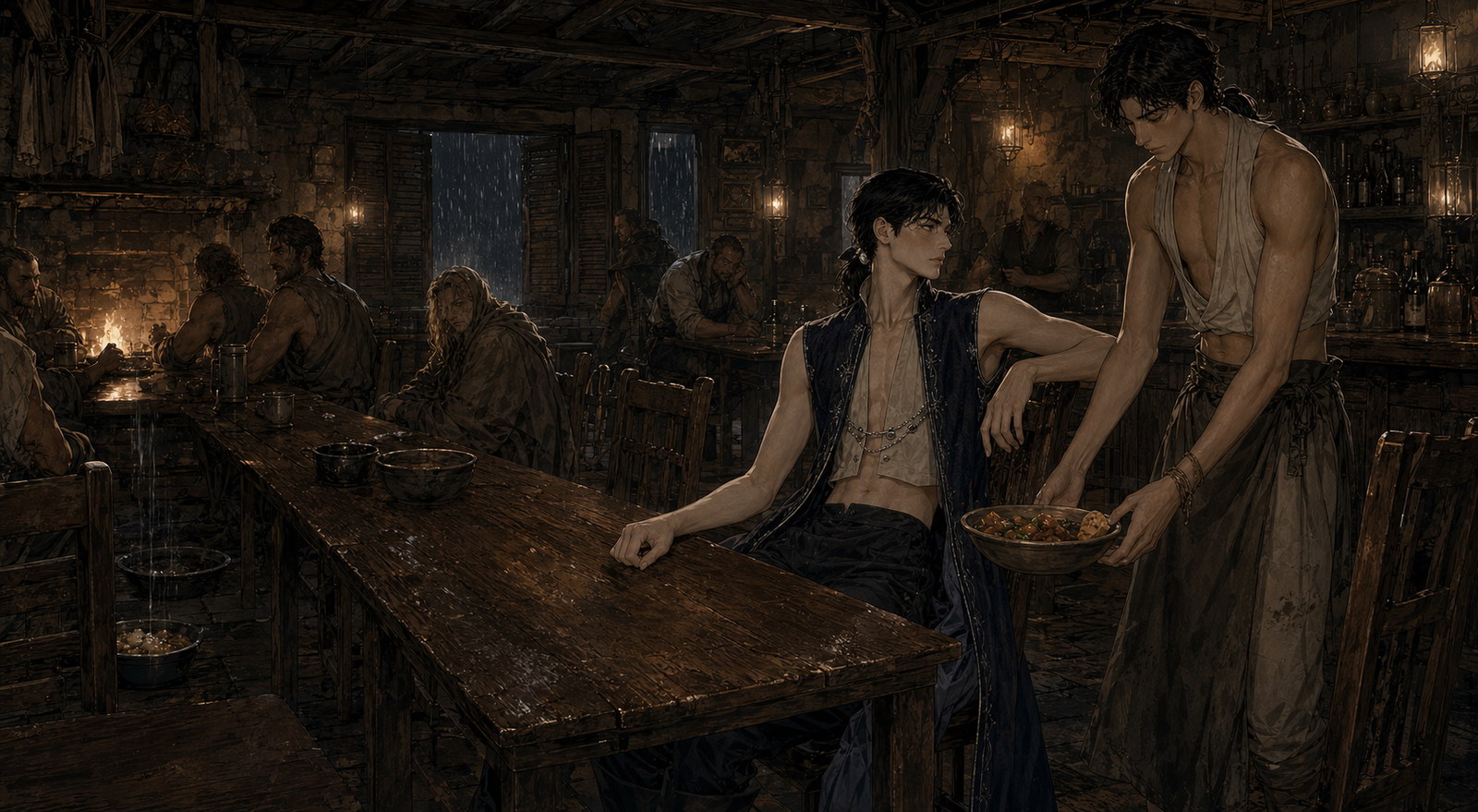
Tobin came from the kitchen carrying four bowls along one arm and a fifth in his hand. He was eighteen that spring, two years older than Ethan and tall enough to seem older still until too many people spoke at once. Fair hair curled damply at his temples, framing a pretty, open face that kept little hidden. A sleeveless linen wrap crossed his chest and tied beneath his ribs. Loose work trousers stopped midway down his calves, while a broad apron protected most of their front and none of the narrow strip of stomach above its knot.
Tobin remembered every regular's supper if the orders came one at a time. He knew who soaked his bread, who wanted salt before tasting anything, and which carters lied about having paid. When the common room grew too loud, he stood beside the flour chest until the voices became separate things again. Ethan liked him because Tobin never pretended to understand a joke he had missed. He simply waited until the speaker explained it or regretted trying.
The empty key cord looped twice around Tobin's wrist had belonged to his mother. She had died of the fever a month before. Everyone who came through the Lantern often knew that much, though nobody mentioned the way Tobin still checked the cord some mornings as if the keys might have returned during the night.
He set old Brannick's bowl down, served the farm brothers, and carried the last to the long table. The boy in blue examined the stew.
“Is this the meat portion?”
Tobin stayed beside the table. “Yes, sir. Lamb.”
“I can see that it is lamb. I asked whether this was the meat portion.”
The room quieted by degrees. Tobin glanced toward Mara, who was drawing ale for the cooper. She had heard, but crossing the room would make it plain that Tobin needed rescuing before he had asked for any.
“There is meat in all the bowls,” Tobin said after sorting the question. “Yours has more.”
The boy moved a piece with his spoon. “Then your more is disappointing. Bring bread.”
Tobin returned with half a loaf. He had turned away when two pale fingers caught the end of his apron.
“You can bring yourself upstairs after the kitchen closes,” the boy said. He did not lower his voice. “Washed, without this sack tied around you. I have coin enough to improve your evening.”
Dice stopped beneath Brannick's cup. One of the farm brothers lowered his spoon and stared into his bowl. Ethan felt heat climb his throat, though the invitation had not been spoken to him.
Tobin pulled his apron free. “I don't go upstairs with guests.”
“You have not gone upstairs with me. That was the invitation.”
“No, sir.”
Tobin walked back to the kitchen. His steps stayed even until the door shut behind him and wooden trenchers clattered on the other side. Cook Ressa said something too low to carry, then struck her ladle once against the pot with enough force to make her opinion plain.
This was not the blue-coated boy's first night at the Lantern. On his last visit, he had drunk through an afternoon, mocked a pair of drovers into leaving early, and departed while a merchant searched every pocket for a purse nobody had seen taken. He had returned before the suspicion cooled and asked after Arlen Hale as casually as another traveler might ask whether the north road was passable. The village had remembered both things even if no magistrate cared to join them.
The boy in blue broke the loaf at its middle and dipped the softer half into his broth. Conversation returned in small, careful pieces. Brannick rattled the dice again. The cooper asked Mara whether the rain would last, though he had lived under the same sky for sixty years and knew she could not answer.
Ethan found that he had closed his right hand around the old ring on his middle finger. It was a dull, dark band marked with shallow lines worn almost smooth. He could not remember a time when it had not been there, and he had never succeeded in pulling it past the knuckle. Master had once offered soap, oil, and a pair of cutting jaws. Ethan had refused the jaws. The ring did no harm, and there were some mysteries a person could keep until he had enough food and time to afford them.
He let go of it and finished his stew.
Mara brought the boy a bottle of spiced cordial after he laid another silver round upon the counter. The bottle was meant to last through Harvest Week. He filled his cup to the rim and drank half before tasting it.
The outer door opened on a gust that bent every candle flame toward the kitchen. Orren Hale filled the doorway, rain running from his beard onto an oil-darkened mantle worn open over his work vest. Mud covered his loose trousers to the knee and his road boots past the ankle. He had forgotten to remove the glove from his left hand, though the right was bare.
Orren searched first for Tobin. Then he saw the blue coat.
Ethan had heard the story of Arlen Hale at the smithy, on the grain cart, and twice within the Ash and Lantern. Arlen had served Mara's tables before he married. He had been quick with figures and quicker with a sharp answer. The black-haired stranger had followed him through the market after repeated refusals, then challenged him before enough witnesses that refusing would have ruined him almost as surely as accepting. Arlen had carried a borrowed sword. By noon the next day he was dead, and his widow had taken their little girl back to Orren's house.
The magistrate called it a lawful duel. No one in the room spoke of it that way.
Orren crossed to the hearth and pulled off his remaining glove. Ethan shifted along the settle, offering him the warmer place, but Orren stayed on his feet.
“Ale,” he said.
Mara drew it. Orren drank at the bar with his back to the room while rain ran from his mantle and pooled around his boots. The boy in blue watched the broad back, finished his cordial, and poured another cup.
For the next hour the inn performed its familiar business with grave determination. Supper bowls went back. Ressa banked the kitchen fire. The farm brothers debated a boundary stone so intently that they did not have to look toward the long table. A wool factor from Briartown began a song, reached the second verse alone, and took refuge in his beer.
Tobin worked the tables nearest the kitchen. Empty cups migrated away from the boy in blue until only his remained. When Tobin came to collect the cordial bottle, the boy pinned it to the table with two fingers.
He ordered another.
“Mara said there isn't one.” Tobin tried the bottle, found it held, and kept his eyes on the fingers rather than the face above them. “She owns the bottles.”
A few people laughed. Tobin turned to see what had happened.
The boy smiled. “Does she own you too?”
Tobin's mouth tightened. “No, and I told you no before.”
“You repeated a word. I allowed you time to reconsider it.”
He released the bottle, then caught Tobin's wrist when the boy lifted it. His thumb pressed into the cords below Tobin's palm. Tobin went very still. His empty hand opened and closed beside his apron.
Mara came around the bar, carrying no weapon and looking as if she needed none. “Take your hand off him.”
The boy drew Tobin one step closer. “He can answer for himself. Slowly, if that helps.”
Tobin struck him across the face.
The slap carried to the rafters. The boy's head turned with it, and a red mark rose along his cheek, narrow at the jaw and broad where Tobin's fingers had landed. Tobin dropped the cordial. The bottle struck the boards, rolled beneath the table, and did not break.
The boy released him. “There. You understood that quickly enough.”
Tobin backed toward Mara, breathing through his mouth. The linen over his chest lifted hard beneath the crossing bands.
“Your keeper made excuses for you last time,” the boy continued. “She said your mother had died, as though grief explained the slowness. I asked if she had been slow too. Mara did not answer me then either.”
Ethan was standing before he decided to rise. His cloak slid from his shoulders and remained on the settle. The room felt cooler without it. His frayed shorts hung from the points of his hips, and every rib showed when he breathed, but Tobin had placed himself between Ethan and a kicking mule two visits before. He had done it without thinking and without asking whether Ethan was worth the trouble.
Ethan stopped between Tobin and the long table. “He said no.”
The boy touched his reddened cheek. “The room has produced a champion.”
“Leave him alone.”
“Or what? You will turn sideways and disappear?”
The laughter did not come this time. Ethan kicked him in the shin.
It was a poor kick, delivered in a split-soled sandal with no room to gather force. The chair scraped back. Ethan shoved at the boy's shoulder with both hands and felt trained muscle harden beneath fine wool.
The boy rose. He was taller by half a head and broader everywhere that mattered. One hand closed around Ethan's upper arm while the other caught the waistband of his shorts. For one strange instant Ethan's feet left the floor and the whole room opened beneath him. Then the boy threw him.
Ethan struck the end of the settle across his lower ribs, folded over it, and slid among the damp rushes. Air left him without permission. He heard a cup set down and saw Orren's boots cross the floor.
Orren moved with the slow, heavy purpose of a man accustomed to lifting things that could not help him. The boy watched him approach. Boredom left his face. What replaced it was not fear.
“You've put your hands on enough boys in this house,” Orren said.
The boy's gaze passed over Orren's wet mantle and broad chest. “I know you.”
“You knew my son.”
“Briefly.”
Orren's bare hand curled until the nails pressed white crescents into his palm. “He told you no. Again and again. You followed him to the market and called him out before half the town.”
“I offered him a fair sum for the service. More than fair, given what he was.”
“My boy wasn't a whore to be bought. He had a wife and child at home.”
The black-haired boy lifted his cup. “Well, he should have taken me up on my offer, then. Children are expensive to raise. Now you have to do it.”
Orren reached for him.
The boy stepped inside the larger man's arms. He caught Orren above one elbow, turned on the ball of his foot, and drove his hip across Orren's path. His other hand struck upward beneath the jaw. Orren's teeth clapped together. His boots left the boards by the width of a finger, and then he crashed through the nearest bench.
The broken wood made more noise than Orren did. He landed on his side with one arm trapped beneath him. His head bounced once. A cup fell after him and shattered against his shoulder.
Ethan managed one breath and crawled toward the hearth. Mara reached Orren first and pressed two fingers beneath his jaw. Blood showed along his lower lip, but his eyes stayed closed when she called his name.
“Ressa, blankets. Brannick, help me move him away from the broken wood.”
Brannick and the cooper lifted Orren beneath the arms. His heels dragged two straight lines through the rushes. Ethan got one knee under himself and followed Ressa with the folded wool, though one arm remained clamped across his own middle.
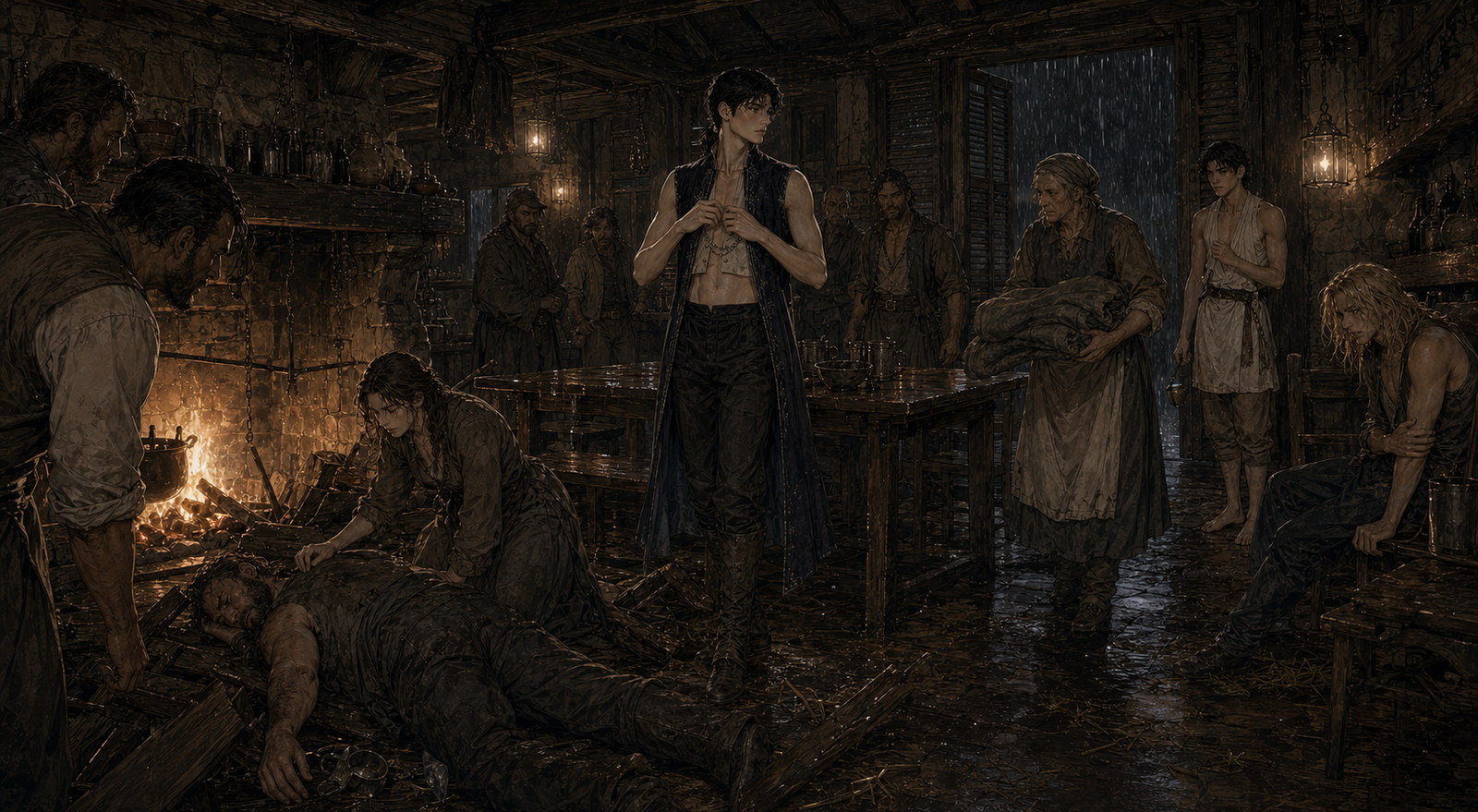
The boy in blue straightened one of the silver chains across his vest. His breathing had not changed.
“He will wake,” he said. “The floor did most of that.”
Mara covered Orren and wiped blood from his mouth. “Go upstairs.”
The boy glanced at the remains of his supper. “I paid for that.”
“You ate it. I gave you the best room. Use it, and at first light you leave my house.”
His attention moved once more to Tobin, who stood behind Ressa with his mother's cord clenched in one fist. “Very well. I was going to bed in any case.”
He climbed the stairs without touching the rail. Every step landed softly despite the cordial. The best-room door closed overhead.
The inn did not become safe when he disappeared from sight. It merely remembered how to move.
Mara locked the remaining bottles in the cupboard. The farm brothers carried the broken bench to the wood store, where Ethan examined the split through watering eyes. The leg had torn along the grain. It could be bored, pegged, and bound beneath the seat with a strap, but not tonight. He told Brannick where to set the pieces so the wood would not twist as it dried. Brannick listened as if Ethan were a craftsman rather than a thin apprentice with straw in his hair, and that small courtesy steadied him more than Ressa's comfrey paste.
Orren lay beside the hearth with cold ash along his jaw. He breathed roughly but regularly. Ethan returned to the settle, retrieved his cloak, and tried to find a position that did not pull at his ribs.
Through the kitchen door he could see Tobin washing bowls. The same bowl remained in his hands through two changes of water. Mara took it from him at last and set it on the draining board.
“You'll sleep in my room,” she said. “I'll take the chair.”
“My blanket is upstairs.”
“We'll find another.”
Tobin rubbed the empty cord around his wrist. “Mam made that one.”
The servants' rooms occupied the narrow end of the upper passage, past every guest door and beneath the steepest slope of the roof. Ethan knew because Tobin had shown him where the stable-loft blankets were kept on his first visit. Tobin's room was last. To reach it he would have to pass the best room.
Mara offered to go with him. Tobin glanced toward the common room, where shutters remained unbarred and water had begun to overflow one of the roof bowls.
“You have to close,” he said. “I can get it.”
He took the kitchen candle. Mara caught his shoulder before he passed her.
“Straight there and back. If his door opens, leave the blanket and come down.”
Tobin repeated the instruction, then climbed.
Ethan watched the light move up the plaster. He considered following. His ribs hurt, his shoulder had begun to swell, and Mara had given him no task. Those were explanations. They did not improve when Tobin's feet vanished above the beam.
Mara set down the towel in her hand and crossed the common room. She had reached the foot of the stairs when the movement overhead stopped.
The best-room door opened.
“No,” Tobin said. The word came clearly through the boards.
Ethan was off the settle before pain could argue. The candle struck the upper wall. Wax spattered the plaster, and Tobin made a sound through his teeth. Mara reached the turn as he wrenched himself free of the doorway. One tie of his linen wrap hung loose against his bare stomach. The boy in blue held the end of his mother's empty key cord.
Tobin twisted his wrist. The cord slipped through the pale fingers. He shoved with both hands against the blue coat, gained one step and then another. A hand caught at his waist. Tobin struck it away and ran.
“Help!” he shouted. “Mara, help me!”
Mara flattened herself to the wall and let him pass. Tobin came down too quickly for the narrow stairs, one palm sliding along the plaster. She caught his arm at the bottom and drew him behind her.
The boy stood at the turn above them. His ribbon had come loose, and black hair lay over one shoulder. A fresh scratch marked the side of his neck.
“He misunderstood me,” he said.
The common room rose around Ethan. Brannick stood beside Orren with the broken bench leg across both hands. Ressa came from the kitchen carrying the iron stirring hook. One farmer took up the wood axe used for kindling; his brother held the heavy clay pitcher from their table. The cooper shut the outer door and dropped the bar into place.
Ethan found himself nearest the stairs. His knees wanted to shake. He planted his worn sandals wide enough that they could not do so without taking the rest of him along.
Mara moved Tobin toward the kitchen. He caught the back of her apron and kept one fist tangled there.
“Stay behind me,” she told him.
The boy descended three steps. “You should consider what you're doing. I have friends who will ask where I am.”
Brannick adjusted his grip on the bench leg. Ressa lowered the stirring hook until its point rested against the boards. Nobody asked the boy who his friends were.
He came down another step. His gaze moved over the axe, the barred door, and the kitchen entrance. Ethan watched him measure each distance. The drink had loosened his hair and put color in his face, but it had not made him clumsy.
“Move,” he said.
Ethan kicked the same shin.
The boy struck down at him. Ethan turned his face and caught the blow across the sore shoulder. He fell into the wall and brought a framed tally board down with him. Brannick swung over his head.
The boy ducked. The bench leg broke against the stair post, filling the air with splinters. He drove a fist into Brannick's stomach, caught the back of his neck, and sent him into the cooper. Both boys went down among stools and muddy cloaks.
The clay pitcher struck the black-haired boy at the temple. It broke in a burst of sour beer. He staggered, caught the stair rail, and tore its lower peg out of the wall when the first farmer charged.
Mara pushed Tobin through the kitchen door and ordered him to bolt it. Tobin began to protest, but she did not let him finish. The door shut, and the wooden bar dropped into place on the other side.
The boy had the loose rail in both hands. He thrust its end into the farmer's chest and knocked him across a table. The wood axe skidded beneath the settle, safely out of reach. Ressa hooked her iron around the rail and pulled. The cooper seized its other end. Boots slipped in beer, rainwater, and scattered rushes while all three strained over the length of polished wood.
The second farmer struck behind the boy's knee with a stool. His leg folded. Brannick rose with blood already running from his nose and caught him around the shoulders. They fell together.
The room ceased to have an order Ethan could follow. He saw pieces. The stirring hook scraping sparks from a nail head. A hand twisted in the blue coat. Brannick losing the broken leg and finding it again. Somebody's elbow opening the boy's cheek from beneath the eye almost to the jaw. The boy rose through them with blood down his face and drove the cooper backward into the door bar hard enough to shake every hanging cup.
Ethan caught one of his legs and held on. A heel drove into his chest, but there was nowhere for him to fly this time. He folded around it, kept both arms locked, and felt the boy drag him half the length of the hearth.
Hands closed again. Boots struck fine wool. The boy reached the long table and tried to pull himself across it, scattering cups and the cordial bottle. Something flashed low between bodies. Ethan saw a dark hilt, then only cloth and knees. The boy jerked. His hand clamped over his left hip, where blood spread through the blue coat and ran between his fingers.
The grip of his trapped leg weakened. Ethan lost it and struck the floor on one shoulder.
The boy tore himself free long enough to gain a backward step. His heel caught the raised border of the hearth. Brannick still had the front of his coat, and one farmer clung to its side, so the boy turned as he fell.
The back of his head struck the broad hearth flags.
The sound was smaller than the fighting and harder than any of it. Ethan felt it through the boards beneath his palm. The boy's right hand opened in the rushes. His head rested at an angle that did not belong to sleep, the dark hair spreading into beer and hearth ash.
Mara put one hand on Brannick's shoulder. “Enough.”
He released the coat. The room came apart from the body by inches. Ressa lowered her hook. The farmer stumbled backward and sat heavily on the nearest table. The cooper remained against the door, holding one side of his chest.
Mara knelt beside the boy and pressed two fingers beneath his jaw, just as she had done for Orren. She moved them once and then again. Blood continued to leave the wound at his hip, but his chest did not rise.
Behind the kitchen door, Tobin called her name.
Mara lifted the bar. Tobin came through holding Ressa's bread knife in both hands. He saw the body beside the hearth and stopped. Mara took the knife, placed it flat on a table, and drew him against her. Tobin stood rigid until his forehead lowered to her shoulder.
“He cannot touch you,” she said.
Ethan sat against the wall with one knee drawn up. Each breath found a new place that hurt. Ressa crouched beside him, felt along his collarbone, and made him move his fingers. When he managed it, she turned to the swelling beneath his eye and wiped away blood that was not his.
The cooper faced the shuttered windows. “Someone will have heard.”
“Everyone heard,” Brannick said.
Rain beat harder on the roof. The bowl beside Ethan's abandoned place overflowed and spread beneath Orren's boots. Orren slept through it, breathing with a roughness that seemed louder now that the other boy had stopped.
Mara released Tobin and surveyed her common room. No one had seen the whole fight. Ethan knew exactly where his own hands had been and almost nothing else. The knife might have belonged to anyone. So might the cut on the cheek, the blow that broke the rail, or the hands that turned the final fall.
“He left,” Mara said. “After Orren fell, he took the north road.”
The cooper wiped his mouth with the back of one hand. “In this rain?”
“He was drunk.”
Ressa helped Ethan to his feet. “He said he knew people in Briartown.”
Mara's face did not change. “Then perhaps they saw him.”
Nobody agreed. Nobody refused.
*
The common room became work because work was the only thing any of them understood well enough to begin.
Brannick fetched the mop. The farmers carried the dead boy through the kitchen and into the stable while Ressa gathered broken crockery. The cooper checked the rain and barred the door again. Mara filled a bucket with cold water, not hot, and showed Ethan how blood fixed into floor grain when scalded. He knelt beside her until she took the rag from him and told him he would be more useful holding a lantern.
The dead boy lay on the stable floor beneath the tack pegs. Without the common room around him he seemed younger, perhaps eighteen, perhaps a little older. Blood had soaked the left side of his coat and matted the hair beneath his head. His beauty had not left, but it no longer controlled where anyone stood.
They stripped him because the clothes would carry a description farther than the face. The sleeveless blue coat, ivory vest, loose trousers, and fine road boots went into an oat sack for the lime kiln. His pockets yielded loose silver, a narrow comb, and a square of clean linen without an initial. There was no sealed letter, household badge, stitched name, or scrap of heraldry.
When the last of his clothing came away, a dark metal ring showed at the base of his soft cock, fitted tight against the pubic bone. It had no seam or hinge. Shallow hooked symbols circled its face.
Brannick tried first with his fingers and then with lamp grease. The band did not move. He fetched small nippers from the tack wall, set their jaws carefully against the metal, and squeezed. They slipped without leaving a mark.
“Again,” the cooper said.
Brannick pulled. The ring contracted visibly into the flesh. He released it at once, swore, and wiped the grease from his hands.
Ethan held the lantern closer. One of the little marks resembled the hooked line on his own ring, though it might have been no more than the way any hand began a curve. He closed his right fist around the lantern handle before anyone noticed where he was looking.
Mara did not waste time on the puzzle. “Leave it. We need him off the road before dawn.”
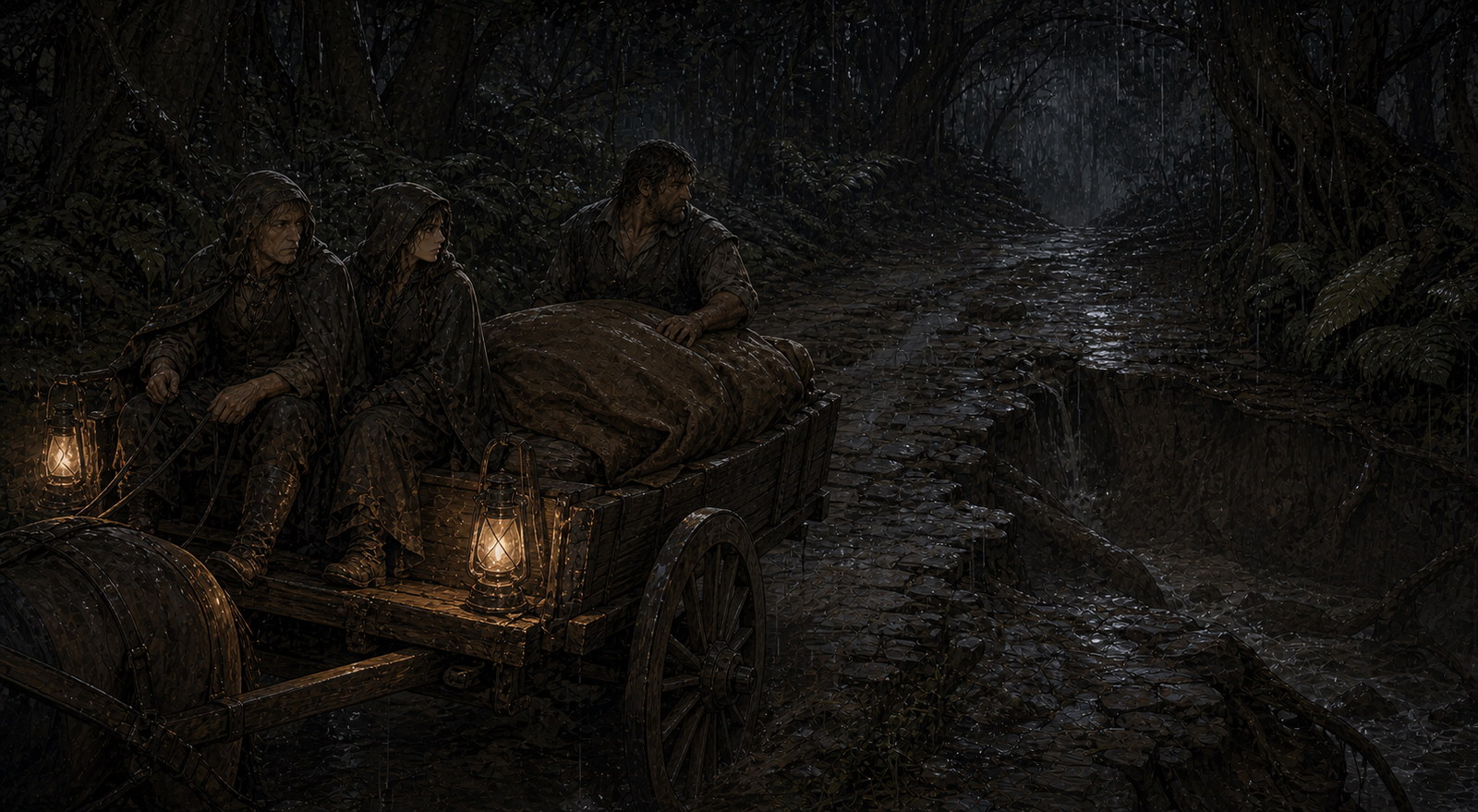
They wrapped the naked body in the same sacking the cooper used for wet staves and loaded it onto his low cart. Mara told him to take the old road north to the Thornwood washout, where roots had broken the paving and spring rain had carried half the shoulder into the ditch. Travelers slowed there even in daylight. A body left below the bank would be found eventually, after weather and animals had made certainty difficult.
Brannick climbed into the back to keep the load from rolling through the deeper holes. Mara took the front bench beside the cooper. No one asked Ethan to come.
He stood beneath the stable eaves with his patched cloak pulled around his aching ribs. Tobin came to stand beside him, carrying his mother's blanket in both arms. He had gone upstairs again while the body was in the stable, this time with Ressa and one of the farmers. The key cord was back around his wrist.
The cart moved into the rain. Its wheels settled into the road ruts, and the lanterns behind the seat painted two wavering circles across the hedges. The sacking rose once when the cart crossed the yard drain, then disappeared beneath Brannick's steadying hand.
Tobin's shoulder touched Ethan's through the damp wool of their cloaks. Neither boy moved away.
They watched until the lanterns passed beyond the last cottage and the rain took them. Water gathered in the wheel tracks almost at once, bright beneath the inn door, while Ethan's right hand remained closed around the ring on his finger.